Friday, October 21, 2022

Live Review: Steel Panther, Airborne

Pic: Barry DouglasMargaret Court Arena


Sometimes a music reviewer needs to set aside their critical faculties and simply relay a series of events. Tonight’s performance by the satirical American hair metal band Steel Panther is one of those times. 


The four-piece opened their set with Goin' in the Backdoor and Tomorrow Night and played some of their best-known songs, All I Wanna Do Is Fuck (Myself Tonight)Poontang Boomerang, as well as their new single Never Too Late (To Get Some Pussy Tonight). Much of the set was given over to comedic commentary. Examples include Satchel’s statement, “The next pandemic is gonorrhoea, and it starts with this guy right here,” while pointing at singer Michael Starr, Starr’s impersonation of Ozzy Osbourne, bumbling around the stage and needing the Heimlich manoeuvre after choking on the head of a fake bat, drummer Stix Zadinia’s hapless shrug after Satchel’s disclosure of his erectile dysfunction and bassist Spyder’s role as the butt of jokes about being new to the band. Both songs and banter were appreciated by the crowd, and it is here that I feel the need to simply disclose facts. It’s how some members of the crowd showed their appreciation that could tie a pseudo-sociologist in knots. When one member of the crowd volunteers to personify Asian Hooker, the crowd cheers as Starr goes on his knees before her to sing, “sucky fucky smells like sushi”. Later, when another woman takes a seat on stage and Spyder’s plea, “I really really really really want to see those titties” is rewarded, it’s hard not to think about agency and who has what power in this situation. But she laughs, the band do their mock “OMG Boobies!” faces like the horny teenagers these guys in their fifties most definitely are not, the crowd cheers, and she nails the hook to one of Steel Panther’s more notable odes to anal sex, Weenie Ride.


After a solo set from Satchel in which he links dozens of iconic metal riffs in some kind of guitar shop employee nightmare, Starr invites dozens of women to the stage. Soon, they are in various stages of undress, and band members are struggling to express just how great they think the bouncing breasts suddenly surrounding them are that it becomes something approximating a sex-positive party. When some of those women start interacting, taking the show from a M to an R rating, and Starr says, “well, this is great, but I don’t see any vaginas”, and...cue vaginas, you can only imagine how horrified the venue’s namesake, noted arch-conservative Margaret Court would be, and laugh. Party Like Tomorrow is the End of the World17 Girls in a Row and Death to All But Metal are raucous anthems that give the band the chance to show how much musical and song writing talent lies under all the hair and makeup, but once the women leave, they really can’t be followed. They try, with an encore of Community Property and Gloryhole, but the energy levels drop and as they group together at the front of the stage, just for a moment, you can see just how much energy a show like this takes.


Energy levels are not a problem for the night’s opening act, local hard rock icons Airbourne. After spending most of the year overseas and with a rare opportunity to play a venue the size of their production, from the opening minutes, it was hard to think of this as anything except a headliner in full force. In front of their own massive flag, a wall of Marshall stacks, a busy light show, explosions of flames, sparks and dry ice and the songs to back all this up, this is hard rock theatre of the highest order. Singer Joel O'Keeffe has so much energy to share that to express it, he must simultaneously crowd surf while running Angus Young-style, play a guitar solo and open a can of beer by smashing it against his head. As black t-shirts and cans of Canadian Club fly through the air, it’s hard to imagine a sound bigger than O’Keeffe’s astonishing falsetto cresting over the band’s smashing cymbals and savaged guitars as they bring Breakin' Outta Hell to a deafening close. After asking the security to allow crowd surfing and tribute to Lemmy Kilmister, It’s All for Rock and Roll, O'Keeffe baptises us all in VB by throwing red cups of the stuff into the crowd, giving the extremely honed band a moment to catch their breath. The NWOBHM-heavy riffage of Runnin’ Wild sees the crowd lose it all over again, bringing the show to a shuddering, howling close. A triumph.


Sunday, October 16, 2022

Live Review: Art of Fighting and Sally Seltmann

Melbourne Recital Centre


“This is such an aesthetically pleasing venue,” says Sally Seltmann, gazing around the honey-coloured interior of the Melbourne Recital Centre. “But it’s intimidating, and I’m such a clutz on stage,” she laughs. “But you should just be yourself, right?” 

Sally Seltmann is exactly who we want Sally Seltmann to be, and during her half-hour opening set we get an insight into her feelings; the risks that come with openness (Heart That’s Pounding), the joy of going to cafes alone (Table For One), uncertainty around devoting her life to music (Seed Of Doubt), how she wished she could write a book (Book Song) – something she later did – and heartfelt reassessments of the past (Night Bird and Please Louise), songs that wouldn’t sound out of place in either iteration of Heartbreak High.


Alone on stage with her Nord Electro 6 synthesiser and her phone from which she triggers sparse rhythm tracks, Seltmann somehow manages to interpret beautifully written and thoughtful songs, while at the same time being a goofball. “This is me folks!” she laughs after stopping a song for the second time because of a forgotten lyric. It feels churlish to say that these moments might be the highlights of a set that includes an overlooked masterpiece like Yes (“And I'll be in your car and driving / Straight through a red light / While you're running through my mind / Arrest me and say yes”), but they join us to her in the moment and amplify every other sentiment expressed. And when you have a personality like Seltmann’s, more is more.


After a brief interlude during which the venue quietly reaches capacity, Art Of Fighting arrive on stage for the hometown show of their Wires tour. The reception is warm, the acoustics perfect and as they commence playing their 2001 album, the backdrop behind them transforms into the first of a series of sketches of a cityscape, a different view of the album’s artwork. 


Art Of Fighting formed in the mid-1990s and released three albums and a handful of EPs before going on hiatus in 2007. In 2019, they returned with the album Luna Low, a release that seemed to fold the intervening years together. Like their previous albums, songs feature two dry Fender telecasters played by brothers Ollie and Miles Browne, Peggy Frew’s restless basslines and occasional hushed vocals and scattering flurries of Marty Brown’s drums. Spread this instrumentation across a song that sits at around 60bpm and apply the turn of the millenia tendency for a white male to sing beautifully in an alto vocal range you have the formula. That may sound reductive, but it’s what the band does with it that makes their music so compelling. Even 20 years on from Wires, the moment they begin it feels like a safe harbour.


Once the glacial pace of opening song Skeletons builds to Give Me Tonight and the crashing crescendo of Akula fades, Ollie fills the silence following another wave of applause and cheering. “We are Art Of Fighting,” he says bashfully. “We’re playing Wires. It’s been 20 years and that’s a long time. I was in the green room earlier and thinking, ‘Wow I can’t believe this album came out when I was five,’” he jokes, keeping his eyes on the floor in front of him. Frew’s warm smile subsides before he adds, “I’ll stick to the music.” The air thickened with dry ice and lights reaching out over the audience, played live Wires is revealed to be an almost monumental study in minimalism. With no guest vocalists, no string section arriving to leaven a chorus and only Miles’ occasional keyboard to flavour the sound, the band work together in a way that seems near telepathic. Part of the power of hearing this music in 2022 is its collaborative nature. With Covid-related restrictions pushing so many musicians to work with technology and so few bands having spent this much time playing together, the sense that this is music borne from hundreds of hours of rehearsals and recordings and concerts becomes almost tangible tonight.


Wires may be best known for beating albums by You Am I, Magic Dirt and Something For Kate at the 2001 ARIA Awards, in one of the most surprising upsets in their history, but these songs never feel like they are striving for anything. There is an effortlessness to every element, as if you’re being trusted with a confession. Ollie may tighten his face to sing a song like Just Say I’m Right, but it feels as though this is from inhabiting a memory, not because he is straining for a note.


After a standing ovation brings them back out for an encore of closing songs from other albums, Heart Translation and Luna Low, which may be the strongest song of the night, there is a sense of grace and restraint to even the loudest moments. Like there are depths yet to be plumbed. With music like this, there seems no reason Art Of Fighting can’t do this all over again in 30 years. Or sooner.


Friday, September 9, 2022

Live Review: Beabadoobee and Molly Payton

Forum Theatre

Outside the Forum Theatre, a queue trails down Flinders Street, onto Degraves Lane and around another block on Flinders Lane. Inside, the room fills quickly with a predominantly female-presenting, refreshingly un-Caucasian crowd with a smattering of fake freckles and a lot of cute backpacks. Entwined couples and groups of friends feed into an atmosphere that is edging on euphoric anticipation, and a sense that this is among the first concerts that many attendees have been to.

Taking advantage of the excitement, London-based Kiwi singer-songwriter Molly Payton proves a great match for the headliner. She and her band occupy the stage with a naturalness that feels emboldening. Payton has an easy demeanour and a huge sound that comprises the mass of shoegaze guitars and arena-sized drum fills yet finds space to draw things to an alt-country intimacy that feels full of confidence and intelligence when she wants to. She finishes her set with the anthemic How to Have Fun and the plaintive jangle of Honey, the opening track to Slack, her recent album that no doubt picked up some more listeners after tonight.

Thirty minutes later, and to a wave of joyous screaming, Beabadoobee arrives on stage, grabs her guitar as the band assembles behind her and launches into her pop epic Worth It. The crowd surges toward her and within seconds at least one fan is pulled over the barrier and out of the crush. “You’re ill Melbourne,” she says hoarsely, as the cymbals shimmer and the guitar fades from the song’s close. “I’m so ill. I’m ill as fuck, but I’m still going to play for you guys.” Today’s meet at greet at Sound Merch in Collingwood was accompanied by a sign that told fans the singer had a sore throat and was close to losing her voice, though tonight it doesn’t sound like it. How much is due to backing vocal tracks isn’t clear, but they’re clearly playing a big part. Regardless of whether it’s all her or she’s miming, the crowd’s devotion never wavers. Some songs (He Gets Me So High, Care, 10:36) inspire a forest of phones and hours of new material for TikTok. Others (Yoshimi Forest Magdalene, She Plays Bass) send an electric shock through the crowd who respond to their opening chords by shaking their heads, filling the room with spinning hair.

On stage, Beabadoobee spends most of the night rooted to her microphone, sometimes edging away with small kicks that – along with any movement or gesture - trigger a swell of excited screams. The eyes of guitarist Jacob Bugden stay glued on the neck of his guitar as he fills the space between his amplifiers and the phalanx of pedals at his feet. Bassist Eliana, the most focused of the quartet, smiles as she plugs away, anchoring the song with her warmth while drummer Luca Caruso does a sterling job in taking the songs away from their backing tracks and making them feel live, loud and immediate.

“This is my favourite track from the record,” Beabadoobee says, her voice notably thinner as she introduces the recent single See You Soon. By the time it reaches the ears of the crowd, even a slower, gentler song like this is turned into a banger with hundreds of arms sent aloft amid a rowdy singalong. Talk, with its chorus of “we go out on a Tuesday” brings even more energy from the crowd and thoughts how many of these songs would be perfect on the soundtrack to 10 Things I Hate About You, the answer, almost all of them.

Even with her voice audibly weakening as the show progresses, it’s clear that she really wants everyone to have a good night. When we call her back for an encore, Beabadoobee returns with just an acoustic guitar and a plea. “You’ve got to sing this song with me OK,” she asks. “You know it, it’s called Coffee.” But, with so many people focused on filming, few people beyond the first few rows join in on the song that made her famous. Regardless, the concert closes on the high-energy high of Cologne, one of her earliest and strongest songs. As Bugden goes all Sonic Youth on his Fender Stratocaster and Caruso pulls out some fierce double-kick and cymbal smashes, the sense of euphoria never drops. These songs are so strong and the connections they’ve made have brought so many people together that, even through illness, this is a triumphant show. It makes you wonder what she could do at full strength.


Friday, August 12, 2022

Live Review: The Smyths, Fleeting Persuasion

Max Watts

On their website, The Smyths explain that they are not a Smiths tribute band. Rather than don ornamental hearing aids and paisley shirts while flinging gladioli in mimicry, The Smyths are focused on evoking the atmosphere of a Smiths gig in the 1980s. Having played over 760 shows in nearly 20 years, it’s entirely possible that tonight’s sold-out crowd will witness the closest thing possible to a concert by the most influential British band of the last 40 years. 

First up however is Fleeting Persuasion who deliver moody, polished mid-tempo guitar pop reminiscent of the music scene that birthed tonight’s headliners. Fronted by Melbourne singer-songwriter J M S Harrison, the band seem more interested in riff and vibe than hooks with songs spiralling out over mesmeric rhythms. It’s a confident move for a band not used to playing in venues this size – to intrigue and lure rather than fight for attention – and it’s one that largely pays off. When they close their set with forthcoming single Etched, the only shame is that the whole gig couldn’t have been accompanied by a low-fi, slow motion early 90s music video, perhaps one caught on Rage at 2am.

Blasting into their set with Heaven Knows I’m Miserable Now, to wild screams of abandon from the crowd, arms, beers and phones aloft, singer Graham Sampson, dressed in black suit and with his spotted shirt unbuttoned to a few inches north of his navel, implores us, as he will do many times this evening, that he loves us dearly. “We got here as quick as the world would allow us,” he says, grasping at his heart before extending his hand toward us. What becomes immediately apparent, even more than the astonishing musicality of the band, is the way that music production has changed since The Smiths left a recording studio for the last time. The fidelity of the music that inspires us all to be here is exceeded in a way that lends the instruments a sense of size that seems appropriate, because it’s Max Watts in 2022, but is also definitely not the sound of an indie band in the 1980s.

William, It Was Really Nothing, Hand in Glove and Panic follow, each sounding louder, faster and more muscular than their original versions and each drawing a wildly impassioned response from the crowd. Guitarist Andy Munro does an astonishing interpretation of Johnny Marr’s guitar playing, managing to make the listener forget that there are at least a dozen other guitar parts (and often strings and synthesisers) augmenting his trickling melodies and slashing chords. Similarly, bassist Simon Hudson reminds you just how remarkable a player The Smiths’ Andy Rourke was. After an imaginative reinvention of There is a Light That Never Goes Out, the band break for an interval, “because we are old men,” Sampson jokes. The happily burbling crowd surge toward the bar, some guessing which songs we’re yet to hear, all seeming very glad they came. 

Returning with The Queen is Dead, The Smyths’ seem refreshed, and Sampson’s voice is in fine form, eager to show us that his falsetto is indeed (quite possibly like yours) stronger than Morrissey’s. The joy of hearing someone even attempt to play these songs, let alone to do so with such skill and attention to detail, is a thrill for anyone with even a passing interest in The Smiths. While Reel Around the Fountain and Last Night I Dreamed That Somebody Loved Me are shorn of their subtleties by the band’s faster and harder approach, songs that can barely contain their own defiant wilfulness such as These Things Take Time, The Boy with the Thorn in His Side and This Charming Man, are triumphs. Sampson’s vigorous thesping suits the songs perfectly, and it never feels as though he is simply trying to be Morrissey, a prospect that has become increasingly fraught over the last decade. Pacing the stage, dropping to his knees, offering his microphone to the crowd to sing choruses and some of Morrissey’s choicest lines, there is so much love in the room that it feels there is no room for doubt.

“You can tell it’s a good gig because my whiff is destroyed,” Sampson tells the crowd. “I’ve been made over,” he smiles. Departing the stage to a blistering Bigmouth Strike Again and returning for an encore of Please, Please, Please Let Me Get What I Want and How Soon is Now that, tribute band or not, provoked so much inarguable joy from the crowd The Smyths could only regard the night as a triumph.


Tuesday, April 5, 2022

Live Review: Martha Marlow, Luke Howard

Melbourne Recital Centre


Walking into the timber interior of the Melbourne Recital Centre, it’s immediately apparent that Martha Marlow boasts a wider demographic fanbase than any other 2021 Australian Music Prize nominee. The Sydney-based singer-songwriter’s album Medicine Man, most of which she plays this evening, is a curiously timeless release, and its lush evocation of seventies-era orchestral folk-pop has found appreciative listeners among entwined young couples and, it would seem, people who bought orchestral folk pop records in the 1970s.


Tonight’s opening act, a man in his early 40s, walks on stage, picks up a microphone and immediately begins talking about the influence of Camus on his next album, All Of Us. “This first song is called A Collective Destiny,” he says, placing the microphone carefully on the top of a Steinway grand piano and taking a seat before it. Speaking on behalf of an audience largely unaware that there would be any support act, a woman shouts, “who are you?” It turns out the man about to bedazzle us with minimalist classical piano for the next thirty minutes, is Luke Howard. Rocking slowly back and forth on the edge of a piano stool, Howard peels out arpeggios and rolling chords in a way that evokes movement in nature, a subtly shifting view from a window and other imagery that likely varies between listeners. It’s beguiling stuff that is already leavening Spotify playlists with names like ‘Rainy Afternoon’ and ‘Chill Piano’ and should rightfully be all over a very successful film soundtrack sometime soon.


Keeping the idea of refinement and precision foremost in the mind of the audience, Marlow’s 17-piece orchestra took their places, then her band, all of whom appeared on her album. The next person to grace the stage is iconic composer and conductor Nigel Westlake. Bowing and accepting the applause appropriate for the man who scored the film Babe, Westlake then welcomes Martha Marlow, who is being led by her father, the double bassist and arranger Jonathan Zwartz, to its centre. Resplendent in a white silk dress, she sits on a stool, keeping one foot on the floor, and puts on glasses on to read lyrics from a music stand.


“I’d like to begin the show with the first song from my album Medicine Man,” Marlow intones evenly in a voice that is part ASMR hypnotist, part shipping news broadcaster. Most songs are introduced with a reading of a specific poem that influenced or inspired it. The first, All My Days, is preceded by a reading of Mary Oliver’s I Go Down to the Shore and further contextualised by Marlow sharing a story about walking to the beach near her house and how the soul-stirring sight of apricot sunsets over rolling waves inspired the song. Many of these poetry readings meet with equally earnest murmurs of appreciation in the audience and it is quietly astonishing, in 2022, to see a performer so earnestly in love with beauty and so passionate about sharing it without a shred of naivety or irony. And then comes the music.


Perhaps it is due to recent years spent listening to digital reconstructions of acoustic or electronic recordings, but the impact of hearing an orchestra and a band performing is almost shocking. With so much attention paid to the writing, arrangement, performance and the live sound, other music seems temporarily weaker. The sincerity with which Marlow writes and sings is similarly remarkable. 

“I called the album Medicine Man because I haven’t been very well, I’m not very well,” she explains by way of introducing the title track, a highlight of the show. “This album is very much an insight into my inner world I take refuge in.” Marlow suffers from an autoimmune disorder that fluctuates in its expression. Tonight it means she is unable to play guitar, but her condition never seems to be a source of weakness. Instead, it seems to charge each action with intent and purpose. 


Moving through the album, songs are rendered with a rich fidelity to their recording. Violins shimmer in unison, guitars blend together with a fulsome warmth that anchors her voice in their midst. Unaffected, breathy and floating, plain and striking, it’s a sound that is all the more powerful for not being showy, sinking into the arrangements as another instrument. Songs such as Rain Man (introduced with a reading of TS Eliot’s Rhapsody on a Windy Night) and River Runs Red (inspired by Chinua Achebe’s novel Things Fall Apart) are rife with imagery and sentiments that speak to nurture and support rather than assertions or declarations. They don’t need copious vibrato or to be separated from the song either in the writing, recording or performance to find their strength. It’s a privilege to be able to see them in a venue that allows their detail to be writ large. Closing with the closest thing she has to an upbeat radio hit I Don’t Want to Grow Up, the revelatory Now I Have You, and What All the Fuss is About, a song from a forthcoming “novel in song” called Notes From Malcolm Harvey, Marlow seems gloriously at home. Though the latter has a chorus against which the estate of Nick Drake could mount a strong case for plagiarism, the sheer grandeur of her vision, and its realisation, is intoxicating. Marlow leaves the stage to applause, and returns when the song has finished to a standing ovation. To have created a show like this from a debut album suggests there will be many more to come.


Friday, March 18, 2022

Live Review: Geoffrey O'Connor, June Jones, Craig Dermody


Northcote Social Club

Like many significant shows of the year so far, tonight’s performance has had a long and tortured journey. Perhaps because the launch of Geoffrey O’Connor’s third album, For As Long as I Can Remember, means the end of multiple postponements, the atmosphere in the room is a fitting mix of quiet excitement tinged with euphoria. His first in seven years, O’Connor’s album features a range of female singers with whom he duets, many of whom are here, the audience is speckled with top tier singer-songwriters.

Within minutes of buoying political news, Craig Dermody steps on the stage, straps on O’Connor’s white Fender telecaster and delivers a batch of sterling tunes. Best known for his work with Scott & Charlene’s Wedding, Dermody’s songs are built over simple chords played first on guitar, then piano and finally over a sparse electro backing track. 

Images drift by over cyclical chords, linked by a recurring sense of looking back at a former life. With close-cropped hair and bare, muscular arms, Dermody cuts a striking figure; a man from a beer commercial singing with regret about a lost love, contentment about work and pride at his “immaculate” scrambled eggs. Dermody occasionally pauses mid-song to apologise for difficulty with his instrument, to laugh off a miss-pitched vocal melody or comment on his nerves, actions that echo the humility and sincerity inherent in all his songs. “Geez it’s good to be playing shows again,” he laughs. It’s good to be there when he does.

June Jones continues the sense of wonderment that still accompanies being at a show. “It’s been a long time since I’ve played an indoor venue,” she says to the by-now nearly packed room. “It’s a bit nerve-wracking, but it’s nice to have good sound.” Easing into her set, Jones is one of Melbourne’s few artists whose profile has risen over the last two years and to watch her performance tonight, there is the sense that the venue is too small for these arena-scale songs. 

Jones’ tenor sits comfortably amid icy melodies, bombastic synth chords and skittering beats that refuse to coalesce into dance music. Singing with what sounds like a doubled and auto-tuned version of herself, Jones’ songs sound not only haunted, but as if her lyrics about social anxiety, medication and the overwhelming sense of global connection, are reinforced. After setting these scenes, Jones’ choruses offer an equally powerful sense of release. They’re astonishingly huge and a thrill after seeing so many smaller-scale shows. That an artist is even thinking on this scale is exciting. “This next song is about going full goblin mode the last two years,” she says with a smile as she leans over her laptop to trigger another banger. “Not sure if you can relate.” 

Throughout the night, the stage has been bedecked with a low Grecian pillar, a pot plant, a glass flower in a glass vase, and an array of modernist screens. Once Geoffrey O’Connor and his band, later introduced as The Choir of Affirmation, arrive on stage looking absurdly sharp, the scene falls into place. It’s a fitting one for an artist who has spent nearly 20 years exploring affairs of the heart with an unremitting attention to detail, someone both ahead of the game, and timeless, and to celebrate an album that feels at once delicate and spacious.

Introducing vocalist Sui Zhen, the set begins with album highlight What A Scene. The band remains in lockstep throughout; slinking grooves, nebulous synth chords and O’Connor’s appealing voice, equal parts leather and champagne. O’Connor seems almost breathtakingly confident as video cameras circle him, documenting the show and giving the audience multiple screens on which to view his searching eyes and elegant cheekbones, framed by faint clouds of dry ice and slicing lights. Zhen is replaced by Nicole Thibault, bedecked in a giant pink bow, for the glistening and sprawling sounds of Shelley Duvall, another exercise in mellifluous harmonies softly cocooning a sad story.

What stops these songs from drifting out of memory is the precise writing and arrangements whose subtle cleverness is easy to miss on a casual listen but which come alive in concert. What makes them even better is the personalities they house. Stephanie Crase adds a low key welcome to Love Is Your Best Friend, June Jones returns for the sleepy morning wake of Tired Of Winning and Sarah Mary Chadwick lends the brief Precious Memories a mournful reverence. 

The evening’s true stars are the band who are given rapturous applause after their mid-set introduction. Flautist and pianist Hank’s sterling flute solos almost steal Catwalk from bassist Caitlyn Lesuik’s compelling vocal take, making the song a highlight. Older tracks, Whatever Leads Me To You and Her Name Is On Every Tongue, come as welcome reminders that O’Connor has always been a wonderfully proficient songwriter. That he chooses to close the set with the album’s title track, for which he is joined by Jonnine Standish of HTRK, and introduced by a brief interlude of aqua aerobic moves, is a thoroughly satisfying end to a gig that managed to bring what seems almost impossible these days, joy. 

Saturday, December 11, 2021

Live Review: The Prize, Smarts, Romero

Brunswick Ballroom

That a gig can be announced and actually go ahead without postponement, live streaming, a change in venue or line-up or the intervention of at least one grassroots music charity in 2021, feels like some kind of miracle. That it is the first-ever headline show for a band with the profile of Romero, seems like another. Tonight, in the long hall of the Brunswick Ballroom, a mix of friends, fans and curious music industry types assembled for a concert that went beyond merely being a good gig, or one that delivered a shot of faith in Melbourne’s live music scene. The combination of bands, venue and crowd made it one of the greatest concerts that this writer has seen in years.

On any other bill, a band like The Prize should be headlining. The fresh-sounding five-piece boasts four singers and three guitarists and brings a blast of cacophonous drums, driving chordplay and melodies. A sound briefly reminiscent of The Undertones or White Reaper, before becoming wholly their own. It seems inconceivable that a band this tight and with songs as good as these is only playing their third show, but it’s been a weird year. Every song is so potent that you’re left half expecting the band to end the set by announcing that they discovered a lost post-punk album and have been playing it track by track. Guitar solos are doubled, giving a twin attack that cuts through the breakneck pace of songs like the opening Easy Way Out and the dynamite Wrong Side Of Town. Absolutely a band to catch.

Another group of musicians who didn’t waste lockdowns was Smarts. Boasting the energy and nerve of a well-oiled Fall, and leavened with the thrilling riffs of saxophonist Stella Rennex, Smarts are a jaw-dropping band. Few songs run longer than two minutes and each is an exercise in taut rhythmic shifts. There are so many stops and starts that it’s hard not to laugh at the intricacy. Melodies and riffs are constantly interrupted, dismantled and abandoned by a flurry of Jake Robertson’s precise drumming or disappear entirely to let Billy Gardner’s distorted bass drive the song toward a new cliff. It’s thrilling stuff and, like The Prize, feels timeless. Smarts are a band Lester Bangs would have loved in 1981, John Peel would have played twice in a row in 1990 and most Melbourne record store owners will enthuse about today. “This is the pop one,” Gardner says wryly before launching into future community radio favourite Breaking The Tradition. It’s glorious stuff.

Having set the bar so high with their choice of opening bands, Romero wasted no time in making their last show of 2021 count. Opening with an Acknowledgement of Country before diving into their latest single, Troublemaker, the five-piece pull the crowd out of their chairs to the stage. Despite a brace of new songs showing that the best is likely yet to come, the band’s first releases Neapolitan and the almighty blast of joy that is Honey are highlights of a stunningly good set. As I asked one member of a more famous Melbourne band at the Luliepalooza festival two weeks earlier as we watched Romero make the crowd their own, “Is Honey the best single of the year?" "Nah," she replied, "best three years at least.” Watching tonight, it’s hard to disagree. The more energy the band put in, the more swooping guitar lines and driving rhythms, the more we get out, as the new song Lady Of The Night proves. Singer Alanna Oliver’s voice cuts through the room like a siren, shaking the chandeliers. “It’s been a sick night,” she says, introducing the night’s final song, the glam stomp banger Halfway Out the Door. She’s not wrong.

Sunday, June 21, 2020

Live Review: NAT VAZER

Small Time


Just hours before Daniel Andrews’ “I’m not angry, I‘m just very disappointed” reintroduction of a state of emergency to manage Covid-19 transmission, new venue Small Time played host to one of the few shows that could run safely. Inspired by Seattle’s radio station-arts community centre KEXP, Small Time had the fortune to open in early March with a focus on live streaming and recording emerging artists, with the venue section of the operation seeing bands play behind soundproof glass to punters seated at tables or on couches. All of which makes for an extremely relaxed space that, with limited ticket sales, makes social distancing a breeze. It is almost as if the venue’s operators knew, in 2019, that streaming and physical distancing would be exactly what the arts industry would be needing in 2020. 

While Nat Vazer has been a fixture on the live scene for several years, her profile has grown from gig opener to supporting Lime Cordiale on their recent tour. May saw the release of her debut album, Is This Offensive and Loud? which earned praise from NME and any music critic who wrote about it, the vinyl selling out its pressing in one week. It’s fair to say expectations are high and the gig feels like one you’re lucky to catch.

Vazer opens the show with a Welcome to Country and her band, guitarist Andrew Campbell, bassist Benjamin Joel and drummer Sean Newell lock in instantly. After months of live shows being something streamed or watched on video, this is a strangely transitional state. More like watching a live-to-air performance, there are no amplifiers or foldback wedges, the band wears headphones, and the sound comes through two mid-sized PA speakers set high in the corners of the room. It’s not hard to imagine that the audience is, like those watching the live-stream of the performance, watching a screen. Unable to hear our applause, but able to see the enthusiasm, the soundproof glass is more than just a physical barrier. We can see Vazer’s precise guitar playing and emotionally powerful delivery, Campbell’s tight-jeaned, bent-kneed rock moves and the dynamic rhythm section of Joel and Newell, but, unlike last year’s incendiary show in the sweltering heat of Nighthawks, it’s more a performance observed than felt.

Tonight, songs that established Vazer as one to watch, such as her 2018 singles Struggletown and the chilling insight into anxiety Keep Away From Parks, are dwarfed by those from her album. Even a rousing cover of Alabama Shakes’ Hold On is overshadowed by newer releases such as the latest single Higher Places, shimmering centrepiece Better Now, and community radio staple, Like Demi. The balance of Newell’s rhythmic proficiency, Joel’s deft bass melodies, Campbell’s imaginative arpeggios and lead guitar lines, the power of Vazer’s voice and the prescience of her songs’ themes combine in a way that feels honed without being too studied. There is a tension in a show that wastes no energy in delivering songs that feel urgent, no sense of desperation or fear that the audience won’t understand. It’s the marker of an extremely good songwriter. 

The world is not short of gifted singer-songwriters and it’s hard to stand out from the brace of new talent that has the fortune or resources to rise to the top of a Release Radar Spotify playlist or onto radio rotation. But these are songs that have the ingenuity to grow on repeated listens, and Vazer has the band to sell them, even with a restrained performance that seems like it was being cut for a live album. 

The show closes with recent single Grateful, which gives each member the chance to loosen up while hewing to a late-period Beatles-esque pop motif. It’s another song that shows Vazer doing what she does best, seducing the ear with a melodic rock song, while only later, with the song circling in your mind, do the lyrics reveal its prickly inspiration. We might have to wait for another small-scale show like this, but if it’s as half as impressive as tonight’s show, it will be worth it.


Saturday, March 14, 2020

Live Review: NEW ORDER, CUT COPY

Sidney Myer Music Bowl

Very occasionally, a concert will be much more than just a public performance of music. The songs of New Order have been woven into the lives of millions of people and to hear them played tonight, to a group who through bravery, passion or idiocy choose to cluster together as the sun sets on a long and mostly horrific summer, makes for an event that at times verges on apocalyptic rapture.

Throughout the night, from the camaraderie of the venue security and crowd, to the joyous dancing throughout the amphitheatre during Cut Copy’s twilight set, to REM’s It’s The End Of The World As We Know It (And I Feel Fine) blasting through the sound system at the evening’s end, this felt like a combination of Danceteria at its peak and watching the orchestra on the Titanic. As Cut Copy’s Tim Hoey says at the close of their set, “This is the last gig we’re going to play for a while, so we’ve got to make it count.”

After visiting the hand sanitiser station on the way in, I am scolded by a friend for arriving too late to see Confidence Man whose set he describes with the gesture of a chef’s kiss. Cut Copy quickly evaporate any feelings of disappointment. The shimmering acoustic guitar and insistent bassline of Feel The Love booms through the venue and it is instantly apparent why they are the perfect band to be opening for New Order.

Cut Copy quietly exist at the centre of the Venn diagram of indie rock and dance and, like the headliners, play a brand of ego-free stadium pop. Tonight’s set draws heavily from their 2008 album In Ghost Colours, which makes sense as it is one of the best Australian albums of the last 20 years. Sun God, from its follow up Zonoscope, is dedicated to the recently deceased DJ and producer Andrew Weatherall, and gives a release from the lymph-system workout that the rest of their set provides.

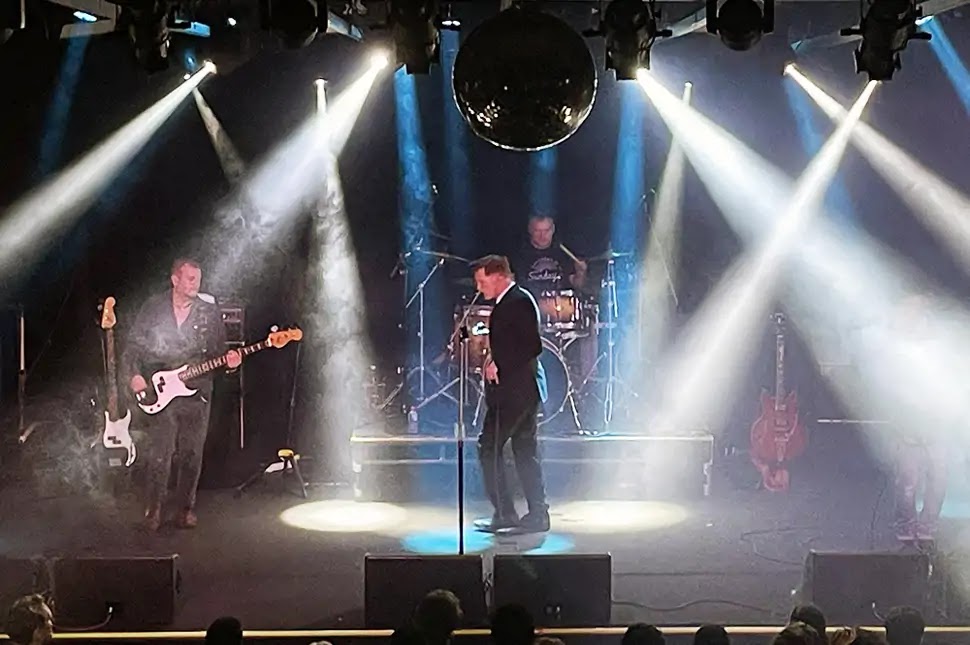
The band also debut an unnamed new song whose rippling arpeggios and scything Blade Runner tones seem better suited to a Sunday morning comedown than a club on a Saturday night. It proves a perfect set-up for the closing duo of Lights & Music and Hearts On Fire whose choruses hit like a euphoric homecoming. “Please look after each other and thank you so much for being here,” says Toey as they make way for New Order’s busying road crew.

From the pitch darkness that envelopes the stadium, an instrumental version of the song Times Change plays as scenes from mid-20th century Melbourne life appear on the screens behind the stage. It’s a disarming move that shows just how British the city looked around the time the members of New Order were born.


“When we started out most bands were placing an emphasis on guitars and power chords at the time,” singer and guitarist Bernard Sumner told the BBC in the mid-90's documentary series Dancing In The Street. “We thought we’d place the emphasis on the drums.” But tonight, the band reverts back to its rock origins with many of the songs being guitar-driven. Right from set-openers Regret and Age Of Consent, songs are given arresting video projections that play out in triplicate on the back of the stage. Cityscapes and digital artwork blend to accentuate the songs' nostalgic power and sense of timelessness. It’s a recurring theme throughout the night, and one that empowers many, especially World (The Price Of Love) whose iconic music video featuring ageing rich holidaymakers adds layers to its themes.

Bespectacled drummer Stephen Morris, seems just as phenomenally metronomic as he was playing She's Lost Control on The Old Grey Whistle Test in 1979. Gillian Gilbert remains a bastion of control and composure, the driver of so many of the band's best-known songs. Seeing this most unlikely couple, the core of this iconic band, playing this music with such utter precision is oddly moving.

Newer songs such as Restless and Plastic are all perfect examples of New Order's latest iteration, without bassist Peter Hook, and with guitarist and percussionist Phil Cunningham and bassist Tom Chapman. While it’s good to hear what these members bring, the band’s back catalogue is so rich and evocative that the newer songs seem like a wanton waste of priceless real estate. These less familiar inclusions also give the audience an opportunity to chat, bump elbows and laugh off any tension.

“This might be the last time we’re all together,” says Sumner in one of his several interludes of chatting with the audience. “But let’s not dwell on that.” For years, people have found exaltation in songs like Bizarre Love Triangle, Blue Monday and Temptation.

Whether escaping the social ills of Thatcher’s Britain, when they were recorded, or amid the anxiety of the early stages of a global pandemic, it seems the greater the oppression, the greater the euphoria of the release. These songs, and especially the surprise encore of Joy Division’s Transmission, a last-minute replacement of Decades, offer this in a way few bands in few times could ever do.


It’s the last time, oh it’s the last...time,” sings Sumner as the slashing guitars and arterial snare drums of Temptation ring out, closing the set. It’s an unforgettable moment, and one that many people tonight will hold on to during the uncertainty of the next few months. Tonight, New Order brought little that was uncertain, much that was prepared and far more than they could have predicted when they booked their show at the Sidney Myer Music Bowl.

Thursday, March 5, 2020

Live Review: BILL CALLAHAN

Hamer Hall

Shortly after the siren tones ring out over the heads of the throng rowdying up the Arts Centre foyer, announcing that Bill Callahan is about to take to the stage, the crowd inside the venue hushes. As latecomers file in, heads bowed, a four-piece assembles in the centre of what seems like a vast stage, and a spell is cast.

The man once known as Smog, with the help of the deft jazz drumming of Adam Jones, Brian Beattie’s electric double bass and Matt Kinsey’s textural electric guitar, sets about bringing his most recent, and most acclaimed album, Shepherd in a Sheepskin Vest, to life. Opening with the welcome of Writing, “it sure feels good to be singing again /From the mountain and the mountain within”, the mood is instantly confessional, sincere and often blackly comic. Cutting an elegant figure on stage, Callahan’s top button remains fastened around his neck, his trousers belted high and his parlour acoustic guitar high over his breast. His silver hair thick, like a television host from the 1960s, his Byrne-esque penchant for running slowly on the spot, seemingly an outlet for nerves, and his rich baritone, the sound of a maple tree being slowly felled, delivered to the audience through a sound system bent on capturing every syllable.

That the set features few songs from before Callahan’s hiatus from 2013 to 2019 speaks to how differently Callahan is connecting to his songs now. With many inspired by the change in his life of marriage, fatherhood, the death of a parent and a reassembled life that was no longer focused around music, songs now express dazzlement at the idea of domesticity. Over and over tonight, Callahan expresses a yearning for the simple and fantastical. “Come with me to the country”, he sings.  “Just you and me”. Or, “I'm just talking about the old days / Groundwork or footwork / Well, after this next song we'll get moving along”. 

Behind these homely sentiments, the band fill the space like physical embodiments of Callahan’s mind, sinuously occupying higher frequencies with cymbal brushes or melodic lines the grow from his strummed chords. The bass balloons through the room before vanishing to ensure not a word of Callahan’s is missed, a quality that could only be born from rehearsals that move from the musical to the telepathic. Older songs such as America and Too Many Birds are given freeform workouts. The first stretches out to allow Kinsey’s guitar to spiral and heave as he pushes against Jones’s rhythms, the second allows Callahan to tell us about his first 24 hours in Australia, time he spent sleep, feeling hungry, wandering the streets at night looking for food, and eating garlic toast, a story he invests with pathos, humour and warmth. It is also impossible to tell whether it was meticulously rehearsed or improvised.

Highlights of the night include a stunning rendition of album highlights 747, Watching Me Get Married and Angela. Dips into his back catalog include Drover, Riding For the Feeling and Seagull. So strong are these songs, and so gloriously are they rendered, that classics such as Jim Cain and songs from his first 12 albums are barely missed. Even a cover of Leonard Cohen’s So Long, Marianne seems oddly a part of Callahan’s collection, and the song’s imagery – “You held on to me like I was a crucifix” – doesn’t seem out of place alongside his, “Like motel curtains, we never really met / And cutting our losses is our best bet”. As he asks in the closing verse of tonight’s opening song, ”Sometimes I have to wonder / Where have all the good songs gone?” Tonight, we’re given bigger things to wonder about.

Monday, February 24, 2020

Live Review: JAY SOM, GENA ROSE BRUCE

Northcote Social Club

A sold out crowd is already tightly packed by the time that Genna Rose Bruce and her four piece band arrive on stage to win over those not already fans. The inventive drumming of Seb, choogling basslines of Eddy and clean lead guitar lines of Cordy guitarist who deft chops should see her challenging for the next Age Music best guitarist award, set off Bruce’s smoky voice and careful strumming. Their set, largely taken from last year’s album Can’t Make You Love Me, shows a welcome disregard for genre as songs move from country pop (Rearview) through indie rock and dream pop, to soul ballads (I Don’t Think I’ll Ever Get Over You) to flirting with minimalist techno (Revive). While there is nothing revolutionary new here, it’s a small mercy to find someone just being good rather than trying to adopt facades of newness. Bruce’s songs move with an energy that makes them an essential addition to any Spotify playlist made for driving, and her show makes a strong pitch for the mid-afternoon slot of a summer music festival. 

“We’re from the States, in California,” says Melina Duterte, aka Jay Som. “This is our last show in Australia and I think it’s sold out so this is insane,” she laughs as the audience cheers. We all seem extremely happy to have put this rapidly ascending singer-songwriter in a good mood at the outset of her show. A show that proves not to be insane at all, but in fact a close encounter with someone who seems very in control of their feelings as they channel it into some extremely captivating songs. From the moment Duterte moves to the microphone to sing the opening lyrics of If You Want it, her lower lip almost touching it, the (surprisingly diverse) audience are collectively won over. The deft melodies, looping bass riffs, swooning guitars and intimate drumming the audience move together so well, the pull is irresistible. Song after song, most of them her acclaimed 2019 Anak Ko, send the audience into raptures. The swaggering pop of Baybee gives way to the album’s delicate last single, the Yo La Tengo-esque Nighttime Drive, the shaker driven pop rush of Peace Out all of which are sublime in the extreme, but none of which compare to one of the singles of the last few years, Superbike with its Cocteau Twins-style harmonies and monolithic shoegaze outro. “We’re a bunch of jet lagged babies up here,” says Duterte, though if anything sleepiness renders these songs even more potent. After anticipating the“cute accents” of the crowd’s vocal contribution to The Bus Song, and expressing her deep gratitude for coming out to see her instead of “you know, clubbing,” the set is wound up with Crown, new single A Thousand Words and Lipstick Traces. The latter shows just how talented her band are, each is given a chance to shine without ever detracting from Duterte’s songs or becoming self-indulgent. It’s a balancing act, beautifully pulled off.

Monday, November 18, 2019

Live Review: U2, NOEL GALLAGHER’S HIGH FLYING BIRDS

Marvel Stadium

On a giant screen that stretches the width of Marvel Stadium, Pedro Pietri’s poem Puerto Rican Obituary scrolls slowly upward. Later, it will show poetry by Judith Wright and Les Murray. Odes to injustice, the tyranny of oppression and the might of the human spirit, subjects that have fuelled Bono’s anthemic righteousness, and given voice to songs so ambitious that it’s hard to believe they weren’t born into arenas. As signs that line the upper tier of this arena remind us, “Marvel Stadium: Epic Lives Here”.

No less ambitious, but with fewer megawatts to their arsenal, Noel Gallagher’s High Flying Birds open their set with the rousing Holy Mountain. Growing from a seven to an eight piece before acquiring a horn trio, the band offer a tight, punchy take on muscular rock and roll with Gallagher’s newer songs boasting the driving dance rhythms of early-90s Manchester. Despite the propulsive energy and a stellar turn from vocalist YSEÉ, the crowd seem barely moved. “Any Oasis fans here?” says Gallagher in a rare moment of not using his favourite expletive. “Well, you’ll like this,” he continues before launching into another very un-Oasis track, Soldier Boys And Jesus Freaks.

There are few acts that could follow a set that closes with Wonderwall, Don’t Look Back in Anger and a stadium singalong of All You Need is Love. Luckily, one of them are about to play their most acclaimed album track by track. To the strains of The Waterboys’ The Whole of the Moon, a spotlight follows each member of U2 as they walk from the stage along a gangway to a prominentary around which a crowd surges, signs, hands and phones aloft. Soon the martial beat of Sunday Bloody Sunday shows that energy is high and the purpose is clear. Early songs I Will Follow and New Years Day are sold with a conviction that few bands a third of their age could muster. Among the crowd in plain spotlights, this is proof that, despite decades of stardom, U2 are still a rock band that would do OK given a weeknight at the Tote.

“Our plan for this evening is for an epic night of rock and roll,” announces Bono. “This is where we let go of some things, and hold on tight to others. I’m here to help. I’m here to surrender to you, to music, to life, to our families. When we surrender, anything could happen.” With this declaration, Bono dedicates the next song, Bad, to Australia’s firefighters, which instantly sees the stadium bathed in the light of around 20,000 mobile phones. As the closing chords of Pride (In the Name of Love) ring out, and the words of Martin Luther King’s “I Have a Dream” speech fade to red on the 200ft-long, 8k screen, the opening chords of Where The Streets Have No Name swell. The Joshua Tree has begun.

Imagery from the American midwest dwarfs the band. Behind them, monochrome highways stretch out, trees sprawl and each of the album’s widescreen epics is given IMAX-style vignettes. We are collectively on a million-dollar budget multimedia nostalgia trip and the band - and their army of technicians - play their part perfectly. The Edge’s guitar is piercing and crystalline, the rhythm section faultless and Bono’s voice is still unlike any other. The experience feels curiously nourishing and the band too don’t seem to be coasting on the quality of the songs and production. Rain falls during I Still Haven’t Found What I’m Looking For, and roadies scramble to protect the equipment. By the time the migrants at the heart of Bullet in the Blue Sky have “run into the arms of America”, the roof has closed and we are locked into the trip. “Here’s where you flip the vinyl over,” jokes Bono as the cheers following Red Hill Mining Town die out, and before In God’s Country begins. 

From here, recollections of the album, and the band’s energy begin to flag. Bono lets the audience take choruses, even when our collective voice grows less confident. The bracing rush of Trip Through Your Wires gives way to the dark clamour of Exit and a forceful version of the closing Mothers of the Disappeared. It is captivating stuff. “That was The Joshua Tree,” announces Bono. “This is what happened next.” From here, we get a tour through the many guises of U2, from the continued fascination with African-American music (Angel of Harlem), Bono’s media-obsessed alter-ego Mr MacPhisto (Elevation) and the spiralling disco of Even Better Than The Real Thing

Though Bono’s spirit is indefatigable, the band’s energy drops again. By the time Beautiful Day arrives, over two hours into the set, the song drags against Larry Mullen’s precise beats. Ultraviolet (Light My Way) gets a feminist makeover via huge images of inspirational women projected behind the band (including Hannah Gadsby, Cathy Freeman, Nova Peris, Magda Szubanski and Greta Thunberg), as Bono explains how poverty is gendered, and like much of the poetry that opened the show, we must consider how our actions impact the less fortunate. We must, he implores us hoarsely, come together as one. 

Killing the lights so that we can sing along in the dark, One is almost entirely sung by the audience. In the dying minutes of the show, as Bono implores us again to set aside our differences and unite, the screen ignites to show an animated assembly of an Australian flag. The crowd cheer as the band finish the song, put down their instruments and huddle together grinning, relieved. Bathed in the light of a symbol of cultural hegemony and in a perfect example of not considering how one person’s actions affect the less fortunate, it is a naive twist to a meticulously constructed and dazzling night.